
03.08.2026
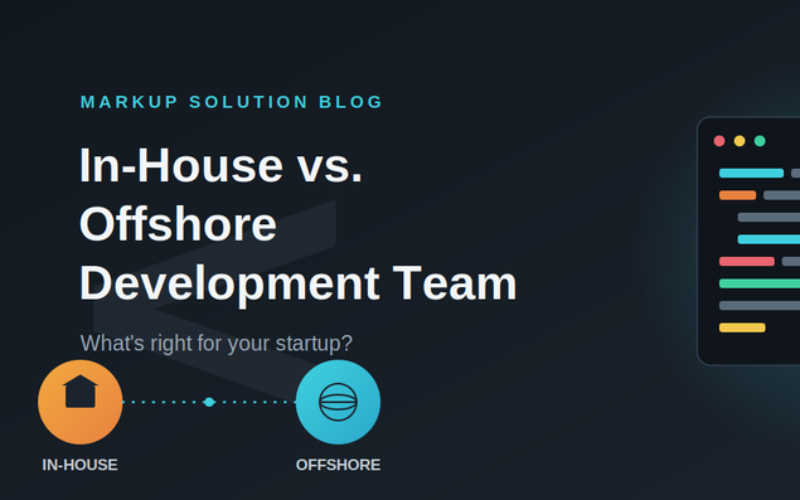
At some point, every founder building a product hits the same fork in the road: do you hire developers in-house, or do you work with an offshore team? Both paths can get you to a working product — but they come with very different costs, risks, and trade-offs, especially in the early, resource-constrained days of a startup.
There's no universal right answer. The right choice depends on your budget, timeline, technical needs, and how hands-on you want to be with day-to-day development. Here's a breakdown to help you decide.
The Case for In-House Development
Full control and alignment
Your developers sit in the same room (or same Slack workspace) as your product, design, and business teams. Communication is instant, priorities shift in real time, and there's no ambiguity about what "urgent" means.
Deep product ownership
In-house engineers live with the product long-term. They build institutional knowledge — why a decision was made six months ago, what broke last time you tried something similar — that's hard to replicate with a rotating outsourced team.
Culture and long-term investment
If your product is deeply technical or your competitive edge is the engineering, building an in-house team lets you invest in people who grow with the company, rather than treating development as a one-off project.
The trade-off: cost and speed
Hiring in-house is expensive and slow. Between recruiting, salaries, benefits, equipment, and office overhead, a single senior developer in the US or UK can cost $120,000–$180,000+ a year fully loaded. Hiring itself can take 2-3 months per role — time most early-stage startups don't have.
The Case for Offshore Development
Lower cost, same output
Offshore teams — particularly in India, Eastern Europe, and Southeast Asia — offer significant cost savings without necessarily sacrificing quality. Experienced offshore developers can cost 40-70% less than their US/UK counterparts, which can be the difference between an 18-month runway and a 30-month one.
Speed to start
A good offshore development partner can often get a team assembled and working within days or weeks, not months. This matters enormously for startups racing to hit a funding milestone or beat a competitor to market.
Access to specialized skills
Need a developer experienced in a niche framework, or someone who's shipped a dozen fintech apps? Offshore agencies often have a bench of specialists you'd struggle to find or afford locally.
Flexibility to scale up or down
Offshore engagements are usually project-based or contract-based, which means you can scale your team up for a big push and scale back down afterward — without the emotional and legal complexity of layoffs.
The trade-off: communication and control
Time zone gaps, cultural differences in communication style, and less day-to-day visibility are real challenges. Without the right processes, offshore development can suffer from misaligned expectations or slower feedback loops.
Head-to-Head Comparison
| Factor | In-House | Offshore |
|---|---|---|
| Cost | High (salary + overhead) | Lower (often 40-70% less) |
| Hiring speed | Slow (weeks to months) | Fast (days to weeks) |
| Communication | Real-time, easy | Requires process, possible time-zone gaps |
| Product ownership | Deep, long-term | Project-based, varies by partner |
| Flexibility to scale | Difficult (hiring/layoffs) | Easy (contract-based) |
| Best for | Core product, long-term IP | MVPs, defined projects, scaling fast |
So Which Should You Choose?
Choose in-house if:
- Engineering is your core product differentiation
- You've raised enough capital to sustain competitive local salaries
- You need extremely tight, real-time collaboration between engineering and other functions
- You're building for the long haul and want to invest in institutional knowledge
Choose offshore if:
- You need to launch an MVP or prove product-market fit on a limited budget
- Your project scope is well-defined and doesn't require constant in-person iteration
- You want to test an idea quickly without a long-term hiring commitment
- You need specialized skills you can't easily find or afford locally
Or consider a hybrid model. Many successful startups keep a small in-house core team — usually a technical co-founder or lead — who owns product vision and architecture, while working with an offshore team for execution, feature builds, or scaling specific parts of the product. This gets you the control of in-house leadership with the cost efficiency and flexibility of offshore execution.
Making Offshore Work: A Few Ground Rules
If you do go offshore, a few practices make a big difference:
- Overlap your working hours, even if only 2-3 hours a day, for real-time syncs.
- Document everything — requirements, decisions, and context — so nothing relies on tribal knowledge.
- Start with a trial project before committing to a long-term engagement, to test communication and code quality.
- Use proper project management tools (Jira, Linear, Asana) so progress is visible without needing constant check-ins.
- Vet for English proficiency and communication style, not just technical skill — this is often the real differentiator between offshore partners.
The Bottom Line
There's no universally "better" option — only what's better for your startup's stage, budget, and priorities. Early-stage startups optimizing for runway and speed often lean offshore; later-stage companies building deep, defensible technology often shift toward in-house teams over time.
If you're weighing your options and want an experienced offshore partner to help scope your project, Markup Solution has been building web and mobile products for startups and businesses for over a decade — with the process and communication discipline that makes offshore development actually work.