

23.01.2026
In today’s competitive digital environment, businesses are constantly looking for ways to build high-quality software while keeping expenses under control. One proven approach is adopting open source technologies. Understanding how open source solutions reduce development costs helps organizations make smarter IT decisions without sacrificing performance or innovation.
Open source software has moved far beyond hobbyist projects. It now powers enterprise systems, eCommerce platforms, content management systems, and cloud infrastructures worldwide. For businesses of all sizes, especially small and medium enterprises, open source provides a cost-effective foundation for building and scaling digital solutions.
Understanding Open Source Software
What Open Source Means
Open source software is software whose source code is publicly available. This allows developers to view, modify, and improve the code according to their needs. Unlike proprietary software, there are no restrictive licenses limiting how the software can be used or customized.
This transparency is a major reason how open source solutions reduce development costs has become such a widely discussed topic in IT strategy.
Open Source vs Proprietary Software
Proprietary software typically comes with licensing fees, usage restrictions, and dependency on a single vendor. Open source solutions, on the other hand, provide flexibility and freedom. Businesses are not locked into one provider, which helps control both initial and long-term expenses.
Why Cost Efficiency Matters in Software Development
Budget Challenges for Businesses
Software development is often one of the largest investments a business makes. Costs include design, development, testing, deployment, and ongoing maintenance. Without careful planning, budgets can quickly spiral out of control.
Open source technologies address this challenge by reducing upfront costs and offering reusable components that speed up development.
Long-Term Cost Planning
True cost efficiency is not just about saving money upfront. It also involves minimizing future expenses. Open source software supports long-term planning by allowing businesses to scale, update, and maintain systems without recurring license fees.
How Open Source Solutions Reduce Development Costs
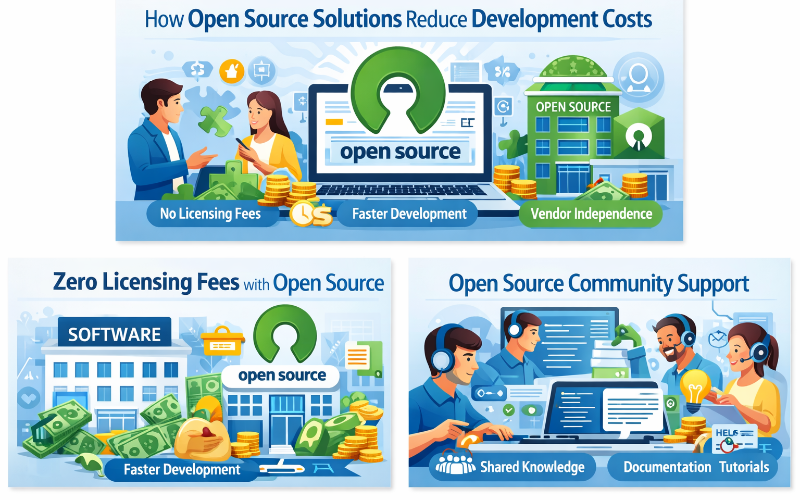
There are several practical ways how open source solutions reduce development costs for businesses.
Zero or Low Licensing Fees
One of the most obvious advantages is the absence of expensive licensing fees. Most open source software can be used freely, even for commercial projects. This alone can save businesses thousands of dollars annually.
Instead of spending on licenses, companies can allocate budgets to customization, performance optimization, or user experience improvements.
Faster Development with Ready-Made Components
Open source ecosystems offer thousands of pre-built libraries, frameworks, and plugins. Developers do not need to reinvent the wheel.
- Reduced development time
- Lower labor costs
- Faster time to market
Community Support and Shared Knowledge
Open source projects are backed by global communities of developers. Documentation, tutorials, and forums are widely available.
This shared knowledge reduces the need for expensive vendor support contracts and lowers troubleshooting costs.
Vendor Independence
With open source, businesses are not tied to a single software provider. They can switch developers or service partners without rewriting the entire system.
Reduced Maintenance and Upgrade Costs
Continuous Improvements
Open source projects are continuously improved by active communities. New features, performance enhancements, and compatibility updates are released regularly.
Businesses benefit from these improvements without paying for costly version upgrades.
Security and Bug Fixes
Open source software often benefits from public code review. Vulnerabilities are identified and fixed quickly by the community, reducing the risk of expensive security incidents.
Scalability Without High Expenses
Flexible Architecture
Open source platforms are designed to be flexible and modular. Businesses can start small and expand as needed without purchasing expensive add-ons.
Pay Only for Customization
Instead of paying for bundled features that may never be used, businesses invest only in the functionality they need. This targeted spending improves ROI.
Common Open Source Technologies Used in Business
- Content Management Systems (CMS)
- eCommerce platforms
- PHP frameworks
- Open source databases
- Linux-based servers
Frequently Asked Questions (FAQs)
1. Are open source solutions really free?
Most are free to use, but costs may arise from customization, hosting, and support.
2. Is open source software secure?
Yes. Public review often leads to faster security fixes.
3. Can open source solutions scale with business growth?
Absolutely. Many enterprise systems are built on open source.
4. Do open source projects have professional support?
Yes. Many companies offer paid support for open source tools.
5. Is open source suitable for commercial projects?
Yes, most licenses allow commercial use.
6. How open source solutions reduce development costs long-term?
By eliminating license fees, reducing vendor lock-in, and lowering maintenance expenses.
Conclusion: A Smart Cost-Saving Strategy
Understanding how open source solutions reduce development costs empowers businesses to make informed IT decisions. By lowering licensing expenses, accelerating development, improving scalability, and reducing maintenance overhead, open source technologies offer a sustainable path to long-term growth.